

Educational Resource | Heart and Mind Counseling
Deep Breathing, Anxiety, and Congenital Heart Disease:
Why Traditional Breathwork Doesn’t Work for Everyone
Reading Time: 10–12 minutes
Many children and adults living with congenital heart disease (CHD) are encouraged to use deep breathing to reduce anxiety, manage stress, or regulate emotions. While these techniques are effective for many people, they do not work for everyone. If traditional breathing exercises make you feel more anxious—or like you simply cannot take the kind of deep breath others describe—you are not alone. Research suggests there may be very real physiological reasons why.
Have You Ever Been Told to “Just Take a Deep Breath?”
It is one of the most common pieces of advice given by healthcare providers, therapists, teachers, coaches, and well-meaning family members.
Take a deep breath.
Breathe into your belly.
Try box breathing.
Slow your breathing.
For many people, these techniques can calm the nervous system and reduce feelings of stress or anxiety.
But for some individuals living with congenital heart disease, those same instructions may feel surprisingly difficult—or even impossible.
Instead of feeling calmer, you may notice:
- A sensation that you cannot get enough air.
- Tightness or discomfort in your chest.
- Feeling more anxious when trying to take a deep breath.
- Frustration because breathing exercises do not seem to work the way they do for other people.
- Feeling like you are somehow “doing it wrong.”
If this sounds familiar, the problem may not be your effort.
It may be your physiology.
Over the past decade, researchers have learned much more about how congenital heart disease and open-heart surgery can affect the diaphragm, lungs, chest wall, and breathing patterns long after surgery is over. Those changes may influence how some people experience traditional breathwork—even decades later.
Understanding why this happens can be both validating and empowering.
Why Breathing Can Feel Different After Congenital Heart Surgery
When people think about congenital heart disease, they naturally focus on the heart.
However, open-heart surgery can also affect other parts of the body involved in breathing.
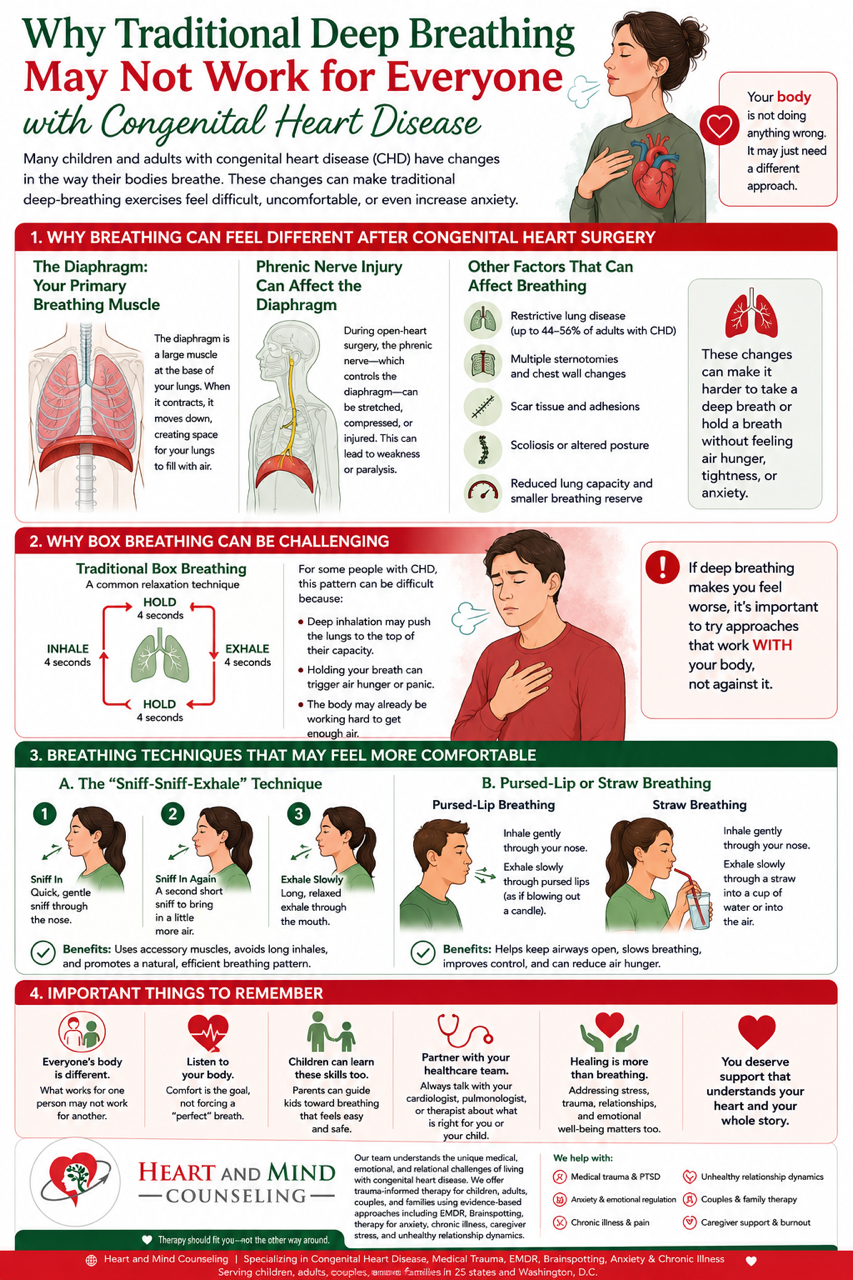
One of the most important structures is the phrenic nerve.
The phrenic nerve controls the diaphragm—the primary muscle responsible for drawing air into the lungs.
Although surgeons take great care to protect this nerve, congenital heart surgery is complex. In some cases, the phrenic nerve may be stretched, compressed, injured during surgical manipulation, or affected by the cooling techniques used to protect the heart during surgery.1–4
When this occurs, the diaphragm may become temporarily or permanently weakened.
This condition is known as diaphragm paralysis or diaphragm dysfunction.
Large studies have found that diaphragm paralysis occurs in approximately 1.2% to 1.5% of pediatric congenital heart surgeries overall, although the risk varies depending on the specific heart defect and surgical procedure. Certain operations—including repairs for Tetralogy of Fallot and ventricular septal defects—have historically demonstrated higher rates than others.2,3
While many patients recover diaphragm function, others continue to experience weakness that may persist for years.
Even more importantly, researchers now recognize that breathing difficulties are not limited to people with complete diaphragm paralysis.
Many individuals develop more subtle changes in the way their breathing muscles work—changes that may not be obvious during everyday activities but become noticeable during exercise, stress, or structured breathing exercises.
It Is About More Than the Diaphragm
Breathing is remarkably complex.
It depends on the coordinated function of:
- The diaphragm
- The lungs
- The chest wall
- The ribs
- The intercostal muscles
- The neck muscles
- The nervous system
Congenital heart disease—and the surgeries used to repair it—can influence several of these systems.
Research has shown that 44% to 56% of adults with congenital heart disease have restrictive lung disease, a rate far higher than that seen in the general population.5–7
For some groups, the numbers are even higher.
Adults who have undergone Fontan palliation or Tetralogy of Fallot repair demonstrate some of the highest rates of restrictive lung physiology reported in the literature.5–7
Restrictive lung disease does not necessarily mean the lungs themselves are damaged.
Instead, it means the lungs and chest cannot expand as easily or hold as much air as expected.
Several factors may contribute, including:
- Previous sternotomies, or open-heart surgeries
- Scar tissue
- Changes in chest wall flexibility
- Scoliosis
- Reduced diaphragm movement
- Altered respiratory muscle function
For many individuals, this simply becomes “normal.”
Their bodies gradually adapt by developing efficient breathing patterns that require less effort.
The challenge is that many traditional breathing exercises were designed for people without these mechanical limitations.
Why Traditional Box Breathing Does Not Work for Everyone
One of the most commonly recommended relaxation techniques is box breathing, sometimes called square breathing.
It typically follows this pattern:
- Inhale for four seconds
- Hold for four seconds
- Exhale for four seconds
- Hold again for four seconds
For many people, this rhythm helps activate the parasympathetic nervous system and promotes relaxation.
But breathing mechanics matter.
For someone living with restrictive lung physiology, taking a prolonged deep breath may already require significant effort.
Holding that breath near maximum lung volume can create an uncomfortable sensation known as air hunger—the feeling that you need more air even though your lungs are already full.
Research on restrictive lung disease has demonstrated that these individuals naturally adopt smaller, more efficient breathing patterns with reduced variability. Even relatively small changes in breathing volume can trigger feelings of breathlessness.8
In other words, your body may already have developed the breathing pattern that works best for your physiology.
When a breathing exercise asks you to override that pattern, your nervous system may interpret it as uncomfortable—or even threatening.
That does not mean the breathing exercise is bad.
It means it may not be the right breathing exercise for your body.
And that distinction is important.
Many people living with congenital heart disease have spent years believing they simply were not trying hard enough.
The research suggests a different possibility:
Your body may be responding exactly as it was designed to.
What Researchers Have Learned About Breathing Muscles
Recent studies using ultrasound have shown that many adults with congenital heart disease demonstrate:
- Reduced diaphragm movement
- Lower diaphragm thickening during inhalation
- Reduced inspiratory muscle strength
- Lower exercise tolerance related to inspiratory muscle dysfunction7
These findings help explain something many people have described for years:
“I can breathe. I just cannot breathe the way people tell me to.”
Understanding this difference changes the conversation.
Instead of asking, “Why can’t I do diaphragmatic breathing?”
A more helpful question becomes, “What type of breathing works best for my body?”
That question has important implications—not only for physical comfort, but also for managing anxiety, regulating emotions, and healing from medical trauma.
Finding a Breathing Strategy That Works With Your Body
One of the most reassuring findings from the research is that deep breathing is not the only way to regulate the nervous system.
For many children and adults living with congenital heart disease, the goal is not to force larger breaths. The goal is to discover breathing patterns that work with the body’s physiology rather than against it.
Respiratory medicine has long recognized that people with diaphragm weakness, restrictive lung disease, and neuromuscular conditions may benefit from modified breathing strategies that reduce the work of breathing while still promoting relaxation.
The “Sniff-Sniff-Exhale” Technique
One technique that many individuals find more comfortable is what we often describe as the “Sniff-Sniff-Exhale” method.
Instead of taking one large, prolonged inhalation, the individual:
- Takes two short, gentle sniffs through the nose.
- Follows with one long, slow exhale through the mouth.
Although this technique feels simple, the physiology behind it is meaningful.
Short, gentle sniffing breaths recruit additional breathing muscles—including the muscles of the neck, upper chest, and rib cage—rather than relying entirely on the diaphragm.9
Instead of asking one weakened muscle to perform all the work, the body distributes the effort across several muscles that assist with inhalation.
This concept is similar to breathing strategies used in pulmonary rehabilitation and neuromuscular medicine, where clinicians may teach breath stacking or other inspiratory muscle recruitment techniques to help patients move air more comfortably.10
Many people describe these shorter inhalations as feeling:
- Easier
- Less forced
- Less anxiety-provoking
- More natural
Rather than struggling to “take one really deep breath,” they are allowing the body to build a comfortable breath gradually.
Why Slow Exhalation Matters
Interestingly, the most calming part of breathing may not be the inhale at all.
It may be the exhale.
During a normal breath, inhalation requires active muscle contraction.
Exhalation, however, is largely passive.
The lungs naturally recoil, allowing air to leave the body without requiring the diaphragm to actively push it out.
This becomes especially important for individuals living with diaphragm weakness.
Instead of focusing all of their attention on taking a bigger breath in, many people experience greater comfort by learning how to slow the breath coming out.
Pursed-Lip or “Straw” Breathing
Another technique frequently recommended in pulmonary rehabilitation is pursed-lip breathing, sometimes practiced by imagining you are blowing gently through a straw.
The technique is simple:
- Breathe in comfortably through your nose.
- Purse your lips as though you are gently blowing out a candle.
- Slowly exhale for longer than you inhaled.
This gentle resistance creates what respiratory therapists call positive expiratory pressure, sometimes abbreviated as PEP.11
Without becoming overly technical, that slight resistance may help:
- Keep smaller airways open longer.
- Slow the speed of exhalation.
- Promote more complete emptying of the lungs.
- Improve breathing efficiency.
- Reduce the sensation of air hunger for many individuals.
Perhaps just as importantly, it often feels calming.
Many clients describe the longer exhale as creating a greater sense of control over their breathing.
For individuals who become anxious during large inhalations, shifting attention toward a slow, comfortable exhale may feel significantly less distressing.
There Is No “Perfect” Breathing Technique
One of the most important messages we hope readers take away from this Educational Resource is this:
There is no universally correct way to breathe for relaxation.
Many popular breathing exercises are extraordinarily effective.
They simply were not designed with congenital heart disease, restrictive lung physiology, or diaphragm dysfunction in mind.
If one breathing technique increases your anxiety, that does not mean breathing exercises cannot help you.
It simply means your body may respond better to a different approach.
Rather than asking, “Why doesn’t this breathing exercise work?”
consider asking, “What breathing pattern feels most comfortable for my body?”
That small shift often changes everything.
What About Children?
Although much of the long-term research has been conducted in adults with congenital heart disease, the findings offer valuable insights for families raising children with CHD.
Parents are frequently encouraged to teach deep breathing as a way to help children manage:
- Anxiety
- Medical procedures
- Pain
- Frustration
- Emotional regulation
For many children, these exercises are helpful.
However, children recovering from congenital heart surgery—or those living with diaphragm weakness or restrictive breathing patterns—may experience some of the same challenges adults later describe.
If a child says, “I can’t take a deep breath,” “That doesn’t feel good,” or “It makes me feel scared,” it is worth listening with curiosity rather than assuming they are resisting the exercise.
Although additional pediatric research is needed, what researchers have learned from adults suggests that individualized breathing strategies may be appropriate for some children as well.
Parents should always discuss breathing exercises with their child’s cardiologist, pulmonologist, rehabilitation team, or other healthcare professionals to ensure the techniques are appropriate for their child’s unique medical history.
The goal is not to create the biggest breath.
The goal is to help children discover breathing that feels safe, comfortable, and sustainable.
Breathing Is Only One Piece of the Puzzle
Learning a breathing strategy that works with your body can be incredibly empowering.
But breathing alone cannot eliminate chronic stress.
Many individuals living with congenital heart disease carry experiences that extend far beyond the physical condition itself.
These experiences may include:
- Multiple surgeries
- Extended hospitalizations
- Intensive care stays
- Painful medical procedures
- Uncertainty about future health
- Feeling different from peers
- Fear surrounding medical appointments
- Caregiver stress
- Difficult family dynamics
- Workplace challenges
- Relationship stress
For some people, these experiences contribute to medical trauma.
For others, the ongoing stress of navigating a chronic medical condition keeps the nervous system in a constant state of vigilance.
Even the healthiest breathing technique cannot remove the source of chronic stress if that stress continues every day.
Sometimes what the nervous system needs most is not another breathing exercise.
Sometimes it needs the opportunity to process trauma, reduce chronic stress, strengthen relationships, establish healthier boundaries, or finally feel understood.
Breathing can help regulate the nervous system.
Therapy can help address the experiences that keep activating it.
For many people, those two approaches work best together.
Healing Is About More Than Breathing
Understanding why breathing feels different can be incredibly validating.
For many people living with congenital heart disease, simply learning that there may be a physiological explanation for their experience is a relief.
It changes the conversation from:
“Why can’t I do this?”
to
“Now I understand why this feels different.”
That understanding often becomes the first step toward healing.
Healing the Nervous System
Breathing exercises are valuable because they help regulate the autonomic nervous system—the system responsible for our fight, flight, freeze, and rest responses.
However, nervous system regulation is rarely accomplished through breathing exercises alone.
Many people living with congenital heart disease have experienced challenges that extend well beyond their diagnosis.
- Living through multiple surgeries beginning in infancy or childhood
- Medical procedures that felt frightening or painful
- Years of uncertainty about health and the future
- Feeling different from peers
- Chronic anxiety about symptoms or medical appointments
- Grieving physical limitations or changes in life plans
- Caregiver stress and family challenges
- Difficult relationships that add to an already overburdened nervous system
Breathing techniques can help calm the nervous system in the moment.
Therapy can help address the experiences that keep the nervous system activated.
For many individuals, lasting healing involves both.
Looking Beyond Breathing
One of the most important lessons we have learned in trauma therapy is that symptoms rarely exist in isolation.
A person may initially seek therapy because they are anxious.
As therapy progresses, they may discover that anxiety has been influenced by:
- Medical trauma
- Chronic illness
- Grief
- Caregiver stress
- Perfectionism
- Difficult relationships
- Childhood experiences
- Ongoing life stress
Similarly, someone who struggles with breathing exercises may discover that the breathing itself is only one part of the story.
Learning a breathing strategy that works with your physiology can make regulation easier.
But healing often also involves reducing the chronic stressors that continue to activate the nervous system.
How Heart and Mind Counseling Can Help
At Heart and Mind Counseling, we recognize that every person’s story is unique.
Some clients come to us because they have experienced medical trauma associated with congenital heart disease, cancer, chronic illness, or other complex medical conditions.
Others seek therapy because they are living with anxiety, PTSD, complex trauma, caregiver stress, unhealthy relationship dynamics, or major life transitions.
Many are navigating several of these challenges at the same time.
Our therapists work with:
- Children
- Adolescents
- Adults
- Couples
- Families
- Caregivers
using evidence-based approaches that may include:
- EMDR (Eye Movement Desensitization and Reprocessing)
- Brainspotting
- Somatic approaches
- Cognitive Behavioral Therapy (CBT)
- Acceptance and Commitment Therapy (ACT)
- Dialectical Behavior Therapy (DBT)
- Mindfulness-based interventions
- Trauma-informed psychotherapy
Our team includes clinicians with specialized experience in medical trauma, chronic illness, congenital heart disease, relationship dynamics, and complex trauma.
We understand that effective therapy is rarely about applying the same technique to every person.
Instead, we believe treatment should be individualized—respecting both the science of the body and the lived experience of the individual.
Our goal is to help each person build a life in which the nervous system no longer has to remain in survival mode.
Key Takeaways
- Traditional diaphragmatic breathing and box breathing do not work equally well for everyone.
- Some children and adults living with congenital heart disease may experience diaphragm dysfunction, restrictive lung physiology, or altered breathing mechanics that make certain breathing exercises uncomfortable.
- Feeling anxious during deep breathing does not necessarily mean you are doing the exercise incorrectly.
- Alternative approaches—including gentle Sniff-Sniff-Exhale breathing and pursed-lip (or straw) breathing—may feel more comfortable for some individuals.
- Breathing exercises are only one component of nervous system regulation. Healing often also involves addressing medical trauma, chronic stress, relationship challenges, grief, anxiety, and other emotional experiences.
- Therapy should be individualized to fit the person—not the other way around.
Frequently Asked Questions
Why does taking a deep breath make me feel more anxious?
For some people living with congenital heart disease, prolonged deep inhalation or breath-holding may create sensations of air hunger or chest discomfort due to restrictive lung physiology or altered breathing mechanics.
Why doesn’t box breathing work for me?
Box breathing is an excellent relaxation strategy for many people. However, individuals with restrictive lung disease or diaphragm dysfunction may find prolonged inhalation and breath-holding uncomfortable.
What is air hunger?
Air hunger is the uncomfortable sensation of needing more air even when your lungs already feel full.
Is it normal to have breathing difficulties years after congenital heart surgery?
Research has shown that some adults with congenital heart disease continue to demonstrate restrictive lung physiology or inspiratory muscle weakness decades after surgery.
Can children with congenital heart disease struggle with breathing exercises?
Yes. Although more pediatric research is needed, some children may experience similar breathing challenges following congenital heart surgery.
Can therapy help if my anxiety is related to medical trauma?
Yes. Evidence-based therapies such as EMDR, Brainspotting, and trauma-informed psychotherapy may help individuals process difficult medical experiences.
Can unhealthy relationships make anxiety worse?
Absolutely. Ongoing relationship stress can keep the nervous system activated, making emotional regulation more difficult.
How do I know if my breathing difficulties are physical or emotional?
Sometimes they are both. Discuss persistent breathing concerns with your medical team while also considering the role anxiety, trauma, and chronic stress may play.
References
- Gerard-Castaing N, et al. Pediatric Pulmonology. 2019.
- Fraser CD, et al. The Annals of Thoracic Surgery. 2021.
- Ruppe M, et al. Journal of Thoracic and Cardiovascular Surgery. 2026.
- McCool FD, Tzelepis GE. New England Journal of Medicine. 2012.
- Lui GK, et al. Circulation. 2017.
- Bhatt AB, et al. Circulation. 2015.
- Spiesshoefer J, et al. International Journal of Cardiology. 2020.
- Brack T, et al. American Journal of Respiratory and Critical Care Medicine. 2002.
- Patel N, et al. Muscle & Nerve. 2023.
- Khan A, et al. Chest. 2023.
- Morrow B, et al. Cochrane Database of Systematic Reviews. 2013.
- Nan H, et al. BioMed Research International. 2020.
- Mamarabadi M, et al. Muscle & Nerve. 2024.
- Kodric M, et al. Journal of Thoracic and Cardiovascular Surgery. 2013.
Medical Disclaimer: This Educational Resource is intended for informational and educational purposes only and should not replace individualized medical or mental health care. Always consult your physician, cardiologist, pulmonologist, or qualified healthcare professional regarding questions about your health or before beginning new breathing exercises or treatment approaches.
About Heart and Mind Counseling
At Heart and Mind Counseling, we believe that understanding is an important part of healing.
Our Educational Resources are developed to help individuals, couples, families, and caregivers better understand the connection between emotional well-being, trauma, chronic illness, relationships, and evidence-based mental health care.
If you or someone you love is navigating trauma, chronic illness, medical trauma, anxiety, relationship challenges, or another significant life transition, our team is here to help.
Healing begins with being understood.